Showing posts with label GIS5999. Show all posts

Thursday, November 28, 2013

Special Topics in Archaeology Final Project


For our final project in GIS5999, we were encouraged to come up with our own project and use many of the tools we've learned over the last year.  

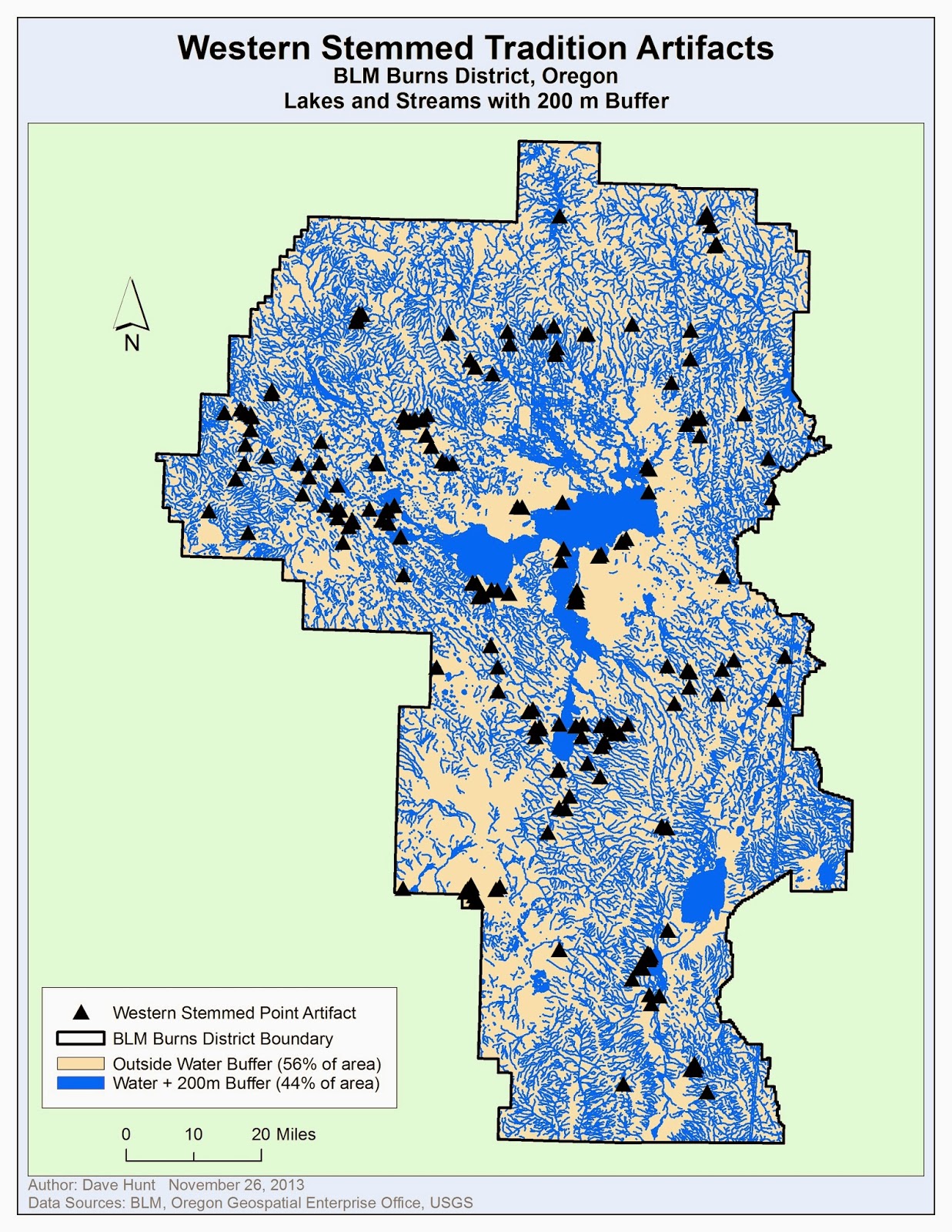
For many decades the first colonizers of the Americas were a group of people called the Clovis tradition.  This has been challenged in recent years by sites that are as old or older than known Clovis sites.  Recently, the Western Stemmed Tradition culture (refers to a style of lithic point) has been found to be as old or older than Clovis.  I was able to acquire the database of WST points for the Oregon Burns District of the Bureau of Land Management.  I've worked at a site in this district for the last couple summers and thought it would be interesting to expand upon this work.  Map 1 shows the distribution of known WST artifacts across the Burns District.
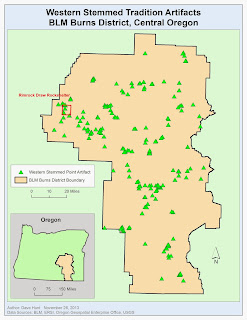
Map 1
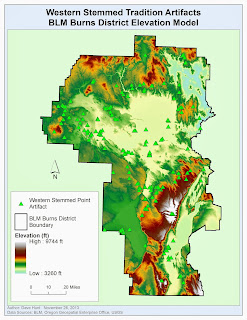
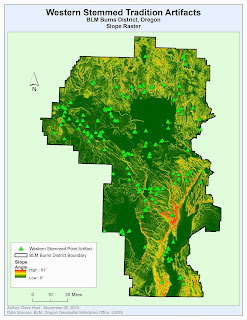
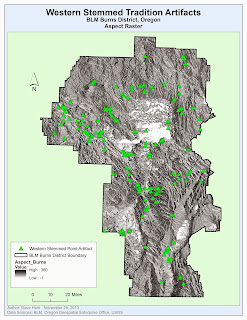
My project involves creating a predictive model.  A predictive model should help archaeologists plan future surveys by highlighting areas that are likely to produce more sites and save time by avoiding areas with low probability of producing sites.  My model will use proximity to water, elevation, slope, and aspect (direction towards the sun) to produce the predictive model.  Map 2 shows all the water features (lakes and streams) in the district with a 200 meter exterior buffer. Map 3 shows the elevation model for the district.  Map 4 is a slope raster produced from the DEM.  And, Map 5 is an aspect raster also produced from the DEM.
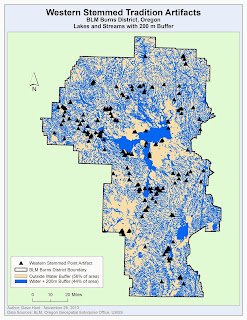
Map 2
Map 3


Map 4
Map 5


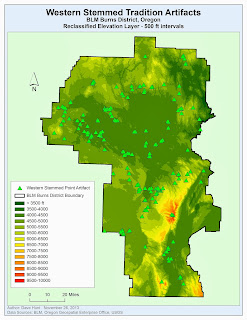
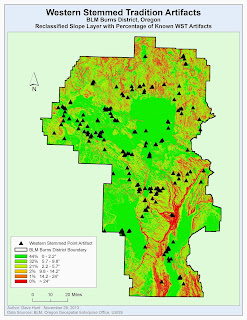
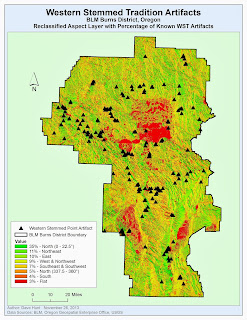
For this predictive model, I had the advantage of having the database of locations for 414 known WST artifacts.  Using this information, I was able to use an ArcMap tool (Extract Values to Points) to determine how artifacts were grouped within each component.  For example, for elevation, I created a layer divided into intervals of 500 feet each (i.e., 4000 - 4500, 4500 - 5000, etc.). Then, using the Extract Values to Points tool, I could determine how many artifacts fell into which interval. From this information, I could determine the percentage of artifacts in each class and Reclassify the raster to hold that value.  Map 6 is the water buffer map reclassified to show that 63% of artifacts occur within 200m of water while 37% of artifacts occur outside that buffer.  Map 7 is the reclassified elevation map, showing that most WST artifacts occur between 4000 and 5500 feet.  Map 8 is the reclassified slope map, showing that most WST artifacts occur on flatter terrain.  Map 9 is the reclassified slope map showing that, surprisingly, most WST artifacts occur in a Northerly aspect.
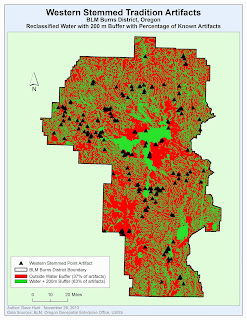
Map 6
Map 7
Map 8
Map 9
The Weighted Overlay tool in ArcMap allows us to assign relative values then to each of these rasters and combine them, based on that value and the reclassified values within them, into a single "weighted" raster.  This combination should provide a whole, more useful than its parts, that can be used to determine which areas are more likely to yield further WST sites.  Map 10 is the final weighted overlay from this analysis. Green areas a good areas to conduct further survey research, red are likely poor areas.  
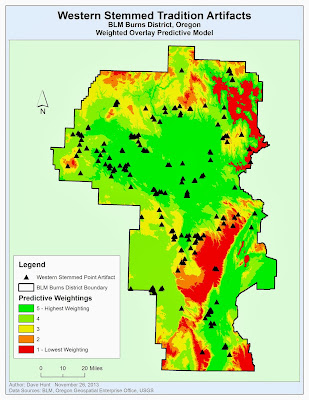
Map 10
Overall, I was a little disappointed with the generalized look of this predictive model.  In the future, I would like to refine it and hopefully tighten up the areas that are most highly weighted. 

In addition to the weighted overlay, I was curious about producing a density map based on known WST artifacts.  This is shown in Map 11.  This map also includes an aerial image of the center of the densest region.  Looking at the aerial, we can see that, in fact, many of the artifacts in this densest region are on the shores of dry lakes.  One area that might help tighten the predictive model is to just use the lakes features and exclude streams.  Streams (and 200m buffers around them) consume an enormous area of the map and perhaps WST people were more inclined to live along lake shores than stream banks.  This is an area I will research further.
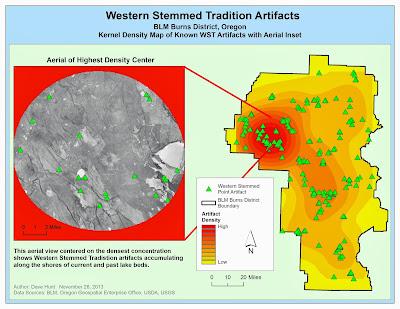
Map 11
Finally, for the graduate student requirement, we conducted some statistical tests on our results.  Map 12 shows the result of a Hot Spot analysis following an Ordinary Least Squares analysis.  The red dots indicate areas where more WST artifacts are occurring than would be expected.  I found it encouraging that my field work is occurring near the red dots in the western-most portion of Map 12.
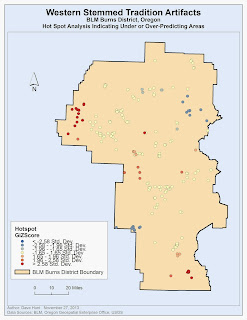
Map 12
Overall this was a pretty intense final lab.  It was a lot of work, but I think the results are useful or will be useful with some further refining.  I am optimistic that we may find some interesting patterns regarding where Western Stemmed Tradition people congregated on the landscape and this may be useful as part of the pursuit for determining who was first in the Americas.

Thursday, November 7, 2013

Biscayne Bay Shipwrecks - Weighted Overlay


This week we continued with our project focused on Biscayne Bay shipwrecks. We began by creating 300 meter buffers around our 5 known shipwrecks to help us understand the benthic bottom types (for example consolidated sediments vs. reef terraces).  These various bottom types are shown in the map above.


The second map takes the benthic bottom and bathymetric layers we created last week and converted them to reclassified layers.  For the benthic bottom types, we grouped various bottom types into 5 classes that have increasing likelihood of shipwrecks (this from external known data).  For the bathymetric layer, we used natural breaks to create 5 groups representing the depths of the areas.  These two reclassified layers are shows above.


The final step was combining these two reclassified layers into one layer.  In doing this, we also wanted to weight one layer more highly than the other (70% benthic bottom type, 30% bathymetric). In doing this, we're saying that we think the benthic bottom type is a better indicator of where shipwrecks might occur.  The final product is the map above, with areas in red indicating areas that we may want to survey in the future to locate more shipwrecks.

Sunday, November 3, 2013

Biscayne Bay Shipwrecks - Part 1


This week begins with the first of a three-part lab involving GIS and shipwrecks!  I am super excited about this lab as this is exactly the reason I signed up for the GIS Certificate program at UWF in the first place.  The first part of this lab is about collecting the data we'll need for later stages of the lab.  We were provided a modern-day nautical chart (left) of Biscayne Bay National Park and the locations of five shipwrecks along the Maritime Heritage Trail (an underwater trail!).  We then had to locate an historical map (center) and the bathymetry data (right, in the form of a digital elevation model) for the park. From this maps, we get a sense of the conditions that led to these ships coming to grief in this particular part of the Florida Keys.

Saturday, October 26, 2013

Scythian Mounds, Final Report


The final lab for the Scythian mounds project involved creating the final predictive results based on our previous work.

Using these surfaces, we created a feature class of random points (minimum 30 m spacing) throughout the study area and merged these points with the possible mounds identified from an aerial image.  This feature class was then expanded with fields and filled with the values from the reclassified surfaces (elevation, aspect, and slope).  These points were then subjected to an Ordinary Least Squares linear regression method based on these three surfaces (top map above).

The results of the OLS give the following results:

               Adjusted R-Squared:   0.760202


Coefficient
Probability
Intercept
-1.770434
0.000000
Aspect
0.115368
0.000001
Slope
0.113834
0.000001
Elevation
0.630913
0.000000

The Adjusted R-Squared value of 0.760 suggests that the three surface variables can explain 76.0% of the sites in the predictive model.

Since the coefficient values are positive (with the exception of Intercept) and not very close to zero, it appears that each surface property is making a positive contributing to the model results (with our reclassified weightings).  The probability values < 0.05 also support this conclusion (near 100% confidence level for each coefficient).

We also subjected our OLS results to a spatial autocorrelation test, returning the following results:

z-score: 11.43385
p-value: 0

The very low (zero) p value indicates that it is very unlikely that the data is distributed randomly.  The high Z-score (in conjunction with the low p value) indicates that the data is normally distributed and spatially autocorrelated.

Based on a visual review of the OLS residuals and hot spot analysis, it does appear that many of the predicted areas are within valley bottoms.  It may be beneficial to add an additional variable that accounts for this spatial distribution, such as access to water in the form of rivers and streams.


It does appear that we have established that the variables in use are helpful for use in a predictive model. Per the lab, it would probably be a good idea to test these variables further with a larger point set and additional regression models (such as GWR).  Additionally the variables should be analyzed further to ensure the relationships are truly linear.  Adding additional variables (such as access to water) may also expose additional relationships.  Finally, any model should be subjected to some ground truthing to understand if it is truly useful.

Saturday, October 12, 2013

Scythian Landscape - Analysis


This week we began our analysis of the landscape around the Scythian mounds at Tuekta.  This consisted primarily of running reclassification operations on various landscape attributes.  The first map (top left) is a simple contour map of the study area.  This gives us a general idea of the elevation where the mounds are found.  The second map (top right) is a reclassification of the slope.  Using this map, we can determine (not at this scale) that the mound areas generally have a slope in the range of 0 - 9.3° (in dark green). This will provide a good guide in the future on areas that might have undiscovered mounds.  The next map (middle left) is a reclassification of the elevation.  From this map, we can determine area that are in a similar elevation band as the known mounds.  The middle right map shows reclassified aspect.  This map shows the directional exposure of the area.  The areas that have a mostly southern exposure (towards sunlight) are highlighted in light blue.  Finally, the bottom image shows my guesses at mounds (some obvious, others not so much) based on an aerial view of the Tuekta area.  These are areas that we may want to explore further.

Thursday, October 3, 2013

Modeling Scythian Landscapes - Part 1


This week we were largely in preparation mode as we start into a module on Modeling Scythian Landscapes.  I am excited for this module as I am particularly interested in landscape archaeology and have been looking forward to attempting to model landscape concepts in GIS.  In the map above, we've created a mosaic of ASTER images as the DEM background for our study area.  In the inset is an aerial view of the mounds that has been georectified to the basemap.  This was all a pretty straightforward process, so we should be good to go for Parts 2 and 3.

Monday, September 23, 2013

Predictive Modeling


This week in Special Topics in Archaeology, we had a pretty interesting lab exercise.  We started with a digital elevation model of the Tangle Lakes Archaeological District in Alaska and some hydrographic information (mostly about the streams and ice mass).  From this raster and features, we were able to create additional raster that indicated favorable slope (for living areas), favorable access to sunlight (more south facing), elevations below the ice mass (warmer), and areas that were within 0.5 miles of a water source (one of the many streams).

With all this information, we could combine all the rasters using a weighting for each into a single weighted overlay (above).  This map shows the areas that are most likely to be inhabited in green and least likely in red. While this was a pretty simple view of this study area, it was a good demonstration of the tools we need to conduct a similar study in the regions of our own archaeological study.

Friday, September 20, 2013

Identifying Maya Periods, Part III + Angkor Wat


For the final week of our Maya Pyramids project, we focused on tools that allow us to share our ArcGIS maps on Google Earth.  We created .kmz files that captured our potential pyramids sites, some of our map views of the sites, and our final map of potential sites (above).


The graduate students completed a "bonus" section creating similar composite views (NDVI in my case) for Angkor Wat which were then used to train and create a supervised classification.  My final classification is above.

The Angkor Wat site seemed fairly "trainable" though I did run into some initial problems.  Apparently it is quite cloudy at the site.  My first download (very large, as we know) of Landsat images ended up covering the site completely.  The second set of images from an earlier date, which is what I used, still had a fair amount of cloud cover, but I was able to work around it.

The site seems to contain a lot of canals and ponds.  These are highlighted quite well by a False Color and especially by the NDVI view.The Supervised Classification, however, seems to not be able to recognize the water (and it is strangely classified as "Urban").  However, the linear nature of the canals and various man-made structures is still obvious. 

The linear indicators helps highlight the extensiveness of the site beyond the monumental core. The site seems to extend at least as far east as it does west (far left of the large rectangular pond).  Similarly, the site seems to extend north and south about the same distance as the height of the central square region.  I'm not sure the Supervised Classification provided a better view of the nature of the site as the plain False Color and NDVI images similarly expose the extent of the site.

Thursday, September 19, 2013

Identifying Mayan Pyramids: Data Analysis


We continued with our attempt to discover Mayan pyramids in the Guatemalan jungle using Landsat images.  This involved using NDVI (Normalized Difference Vegetation Index) and also mixing some of the Landsat bands to try to find a combination that allowed us to identify a pattern we could use for searching for additional pyramids.  Once we identified a pattern (not so easy, more below) we would train ArcGIS to identify this pattern with pyramids and analyze the entire 4-5-1 band composite for us.

This was a difficult lab for a couple reasons.  First, ArcGIS just seems to have some inherent performance bugs when dealing with the raster operations for these large files.  I have a fairly high-performance computer and it really came to a crawl in a few instances (restart/reboot sorts of instances).  Second, the known Mayan pyramids that we were looking at were never more than mere smudges on the (fairly) low resolution Landsat images.  I could see the Mirador pyramids in the ERSE imagery basemap but really couldn't see anything definitive in the Landsat images regardless of the processing we put it through.

Overall, I liked the idea of the lab and I think it could be used to good effect if we had higher resolution images to manipulate and train.

Remote Sensing Mayan Pyramids: Week 1


For our first few assignments in Special Topics in Archaeology, we are doing something pretty cool - we'll be analyzing Landsat imagery to explore for Mayan pyramids in the Guatemalan jungle.  We began experimenting with and combining various bands from the 8 bands available from Landsat.  The different combinations each have different advantages.  The image above shows three of the possibilities. Landsat Band 8 provides the highest resolution of the Landsat bands (15m panchromatic). Natural Color combines the visual spectrum bands (Landsat Bands 1 - 3) and includes pansharpening (using Band 8).  False Color combines the green and blue spectrum (Bands 2 and 3) with the Near Infrared (Band 4) to highlight biomass.

We still don't have a great view of the pyramid at Mirador, but we will continue to home in on it in the following weeks.